Last updated November 17, 2026


Free written scope consultation - allowances, timeline, and change-order rules on paper before a single trade is scheduled
Driveway & Pavers Maintenance Checklist for McKinney Homeowners
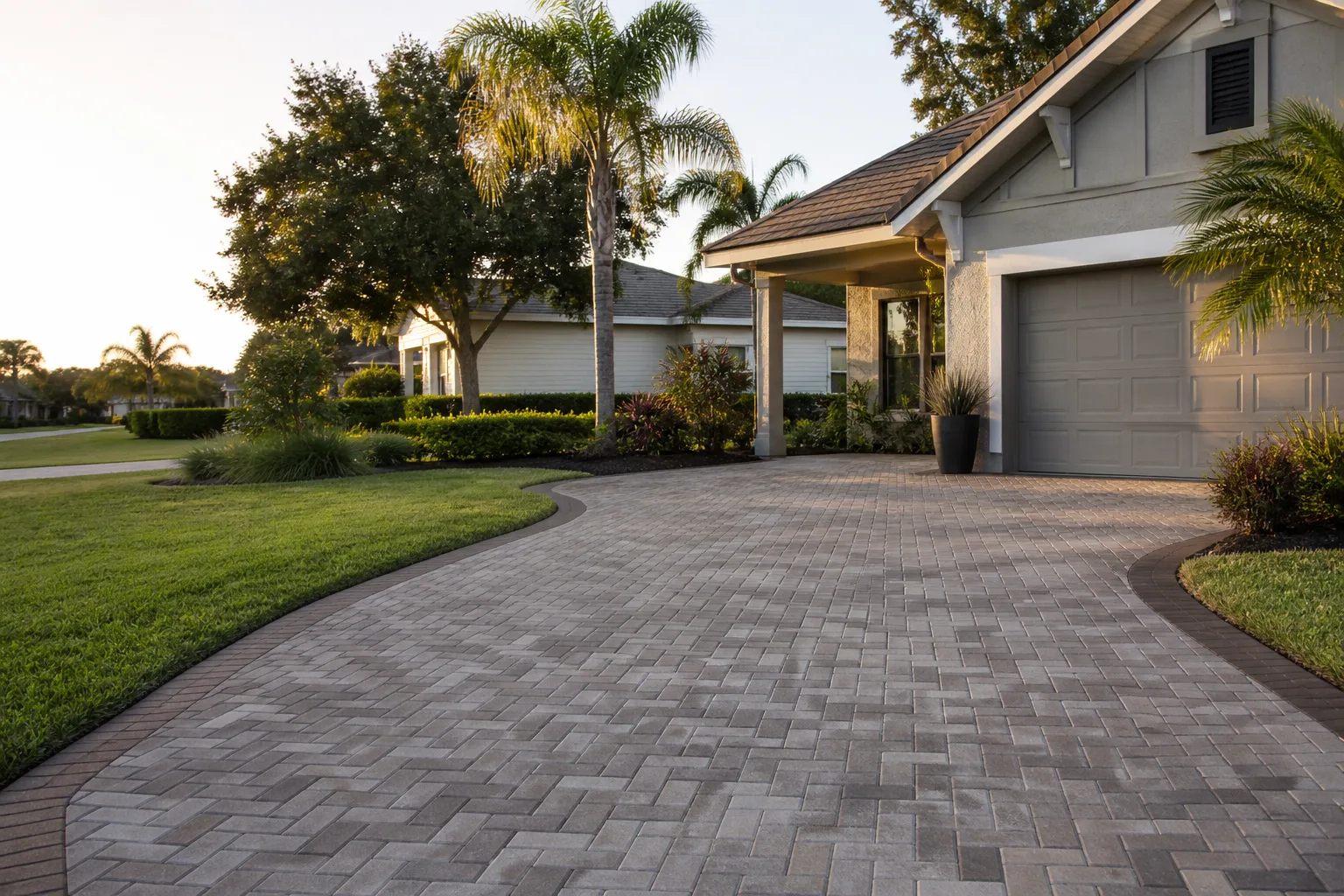
A paver driveway that looks flawless in April can show sunken sections and widened joints by October. Not because the installation was bad, but because nobody re-sanded the joints before summer hit, and nobody caught the grade shift the clay subbase made during the spring wet season. McKinney sits on expansive Blackland clay, bakes under triple-digit July afternoons, and gets just enough winter moisture to move that clay around. Generic nationwide maintenance advice misses all three of those forces. This guide replaces the generic checklist with a month-by-month protocol built for McKinney conditions, covering how to read subbase movement, when to re-sand with polymeric sand, how to protect drainage before storm season, and the go/no-go thresholds that tell you when to stop DIY-ing and call someone.
Quick Answer
Driveway and paver maintenance in McKinney comes down to four recurring jobs: re-sanding joints with polymeric sand before summer heat, clearing drainage channels ahead of spring storms, sealing concrete in fall rather than spring, and inspecting the subbase after wet seasons for clay movement that a homeowner can’t correct alone. Done on a seasonal rhythm, these tasks extend the working life of a paver or concrete driveway considerably. Skipped, they let small joint gaps and minor settling become trip hazards and washouts within a season or two.
Styles & brands we work with
- Kitchen remodeling
- Bathroom remodeling
- Home additions & ADU
- Roofing
- Windows & doors
- Driveway & pavers
- Fence
Table of Contents
- How McKinney’s Clay Subbase Behaves Under Pavers
- The Right Window for Polymeric Sand Re-Application
- Drainage Inspection Before Storm Season
- Seasonal Concrete Sealing Schedule for North Texas
- Root Intrusion From Post Oak and Cedar
- The 15-Point Annual Inspection Checklist by Season
- Repairs You Can Handle and Repairs You Shouldn’t
How McKinney’s Clay Subbase Behaves Under Pavers
Blackland clay is the single biggest reason a paver driveway in McKinney behaves differently than the same driveway built on sandy or gravelly soil. Clay holds water, then swells. It dries out, then shrinks. That swell-and-shrink cycle is slow, measured in fractions of an inch, but it repeats every year and it works on the subbase under your pavers the entire time.
Normal settling looks like this: a slight dip in one corner where traffic concentrates, pavers still tight against each other, joints still full of sand, no visible change at the driveway edges. That’s cosmetic and often correctable with a lift-and-reset of a few units.
Clay movement looks different. Watch for these signals:
- A wave or ripple across several courses, not a single low spot. When the whole field undulates, the base layer is moving, not one paver.
- Joint gaps that reopen within weeks of re-sanding. New sand washing or draining out that fast means water is getting under the bed and pushing through.
- Separation at the driveway-to-garage or driveway-to-street transition. Clay swell often shows up first where the pavement meets a fixed structure that doesn’t move with it.
- Ponding that wasn’t there last year. A new puddle after rain means the surface grade has shifted, and water is now finding a low point it didn’t have before.
- Edges that have spread outward with no retaining restraint holding them.
If you’re seeing single-paver dips, that’s normal settling. If you’re seeing a pattern across the field, re-sanding won’t fix it. That’s subbase work, and it’s the point where a McKinney homeowner should get eyes on it. Our driveway & pavers team handles subbase correction as part of a broader hardscape scope, which matters because the driveway doesn’t exist in isolation from the grade around it.
The Right Window for Polymeric Sand Re-Application
The most common maintenance mistake in McKinney is treating joint sand as an annual chore done “whenever.” Polymeric sand has a specific installation window in North Texas, and applying it at the wrong time wastes the product and shortens the interval before you need to do it again.
Polymeric sand needs to cure without rain and without extreme heat driving the moisture out of the binder too fast. In McKinney, that window is late October through November, and again in March through early April if joints need a touch-up. Do not apply in July or August. Surface temperatures on a full-sun paver driveway run hot enough to flash-cure the polymer before it sets, which leaves a crust that fails within a single season.
Which products hold up in 100°F-plus heat? Look for polymeric sands formulated for high-temperature climates, typically the ones with a higher polymer content and a stated heat resistance in their technical data. Avoid basic kiln-dried sand for joint fill on a hot-climate driveway; it washes out and blows out. The joint fill needs to be a polymeric or a stabilized sand rated for the climate.
Here’s the re-application process, in order:
- Clean the joints completely. Pressure wash on a low setting, then let the driveway dry for 24 to 48 hours before sanding. Wet joints will reject the polymer.
- Replenish missing sand first. Joints that are half-empty need two passes, not one deep pour.
- Sweep the sand in at a 45-degree angle to the joint lines, working in sections.
- Compact with a plate compactor fitted with a rubber pad to work the sand down into the joint.
- Top off and sweep clean, then mist with water per the product’s instructions and keep traffic off until fully cured.
The right interval in McKinney is roughly every two to three years for a healthy driveway, not annually, unless joints are visibly losing fill after winter rains. Re-sanding too often is wasteful; skipping it long enough for joints to open is what lets water into the subbase.
Drainage Inspection Before Storm Season
North Texas spring storms deliver a lot of water in a short window. Paver driveways handle that fine when the drainage is clear and fail when it isn’t. Water that can’t run off the surface finds its way down through joint gaps and channels under the bedding layer, and once the clay underneath is saturated, it takes the sand with it.
Inspect the drainage before the first big storm system of spring. Here’s the sequence:
- Walk the perimeter of the driveway after a rain and mark every place water pools or runs the wrong way. Note these areas.
- Clear every channel drain, trench drain, and grate of leaf litter, seed pods, and soil.
- Check the swale or grade along the edges. If landscaping or mulch has built up over the edge of the pavers, water will be directed back onto the driveway instead of away.
- Look at the downspouts. If gutter downspouts discharge onto or near the driveway, extend them well clear. Water from a roof concentrates into a small area and moves fast.
- Inspect the driveway-to-street apron drain, if you have one, for debris and sediment buildup.
- Check the soil next to any retaining walls or raised borders for erosion or washout behind the edge restraint.
Washout under the bed is the expensive failure. It starts as a rut at an edge and ends with pavers dropping into a void. Catching it during the pre-storm walk is cheap. Fixing it after the subbase has moved is not. If you’re also dealing with standing water in the yard that runs toward the driveway, that’s a grading question, and grading scope sits alongside our fence installation work when we’re correcting the grade line around a property perimeter.
Seasonal Concrete Sealing Schedule for North Texas
For a concrete driveway in McKinney, fall is the better sealing season than spring, and the reason is ultraviolet load. A concrete sealer cures and cross-links through a chemical reaction that drives moisture out of the film. When you apply in spring, the sealer cure window sits right in front of the strongest UV months of the year, when surface temperatures on full-sun concrete are at their highest. The film skins over quickly, solvent or water escapes unevenly, and the cured film is weaker and more prone to hairline cracking than a film cured in moderate temperatures.
Applying in October or November means the sealer cures in cooler temperatures and lower UV intensity, producing a denser film that holds up longer into the following year. The trade-off is timing. Seal at least two full seasons after a new pour, so the concrete has finished its initial moisture loss.
A practical sealing schedule for McKinney:
- Fall (October-November): The main sealer application window. Surface temperature should be on the way down, not at peak.
- Spring (March): Touch-up window if the fall coat was thin or if a new pour needs its first coat after its cure period.
- Summer: Inspect only. Don’t apply in the heat.
- Winter: Inspect only. Watch for new cracking at expansion joints.
Before sealing, fill any cracks wider than a hairline with an appropriate crack filler, and call out any spalling or delamination to a contractor. Sealing over a failing surface doesn’t fix it. The same climate logic shows up in other exterior work too – our roofing recommendations weigh North Texas heat and UV the same way, and the material comparisons on the roof span GAF, CertainTeed, Owens Corning, IKO, Atlas and Tamko, which lets us match the product to the climate rather than the other way around.
Root Intrusion From Post Oak and Cedar
Post oak and cedar are common along McKinney properties, and both send roots where you don’t want them: under the driveway edge and into the base layer. A tree that was ten feet from the driveway ten years ago is closer now, and the root zone has expanded.
Watch for these signs:
- Pavers lifting or rocking at the driveway edge nearest the tree.
- Cracks in concrete running in a line toward a tree, not across traffic lanes.
- A gradually rising edge line where the tree canopy overhangs.
- Surface roots visible in the soil adjacent to the driveway.
The fix at the edge often has two parts. The roots need a barrier or appropriate pruning, and the driveway edge needs a proper edge restraint. Pavers held only by friction at the edge will move when roots push against them. An actual concrete edge restraint, set into a small footing, holds the field in place. For concrete, root-lifted slabs need a root barrier installed along the edge, and possibly a section of slab replaced. The barrier goes in before the paver or concrete repair, not after. Getting this order wrong is one of the most common reasons a repair comes apart within a couple of seasons.
If you’re adding a driveway or widening one while you’re at it, our home additions & ADU scope frequently touches driveway and parking hardscape as part of the same site plan, and that’s the point where tree location and root barriers get designed in rather than patched later.
The 15-Point Annual Inspection Checklist by Season
This is the full inspection, organized by season so you aren’t trying to remember fifteen things at once. Each item comes with a threshold that tells you whether to keep watching or call someone.
Spring (March-April)
- Joint fill level. Walk the driveway and look down at the joints. If you can see daylight through the joint to the base, that’s a re-sand. If more than a third of the joints are open, it’s a full re-sand before summer.
- Drainage channels. Confirm every drain is clear. Standing water 24 hours after a rain is a call.
- Edge restraint integrity. Pavers that move when you step on the edge are loose. One or two, watch; a run of them, call.
- Concrete expansion joints. Any joint with vegetation growing out of it or that has opened wider than the width of a pencil is ready for filler.
- Tree root pressure. Any lifting at the edge nearest a tree is a call – barrier or pruning is the fix.
- Heat-related movement. Single-paver pops or slight dips in the middle of a course. Cosmetic – reset at the next available window.
- Concrete surface condition. Look for new hairline cracking or chalking. Chalking indicates the sealer has worn thin.
- Weed growth in joints. If weeds are returning within days of pulling, the joint fill has lost its polymer content and needs a re-sand.
- Slab curling at concrete edges. Small lifts under half an inch, monitor. Larger, call.
- Seal the concrete. This is the application window. Clear cracks first.
- Re-sand pavers. The main re-sanding window if joints need it.
- Drainage test before the next storm. Run water on the driveway and watch where it goes. Every low spot gets noted.
- Edge and perimeter review. Check the swale or grade and clear any new buildup.
- Joint and crack review. Note any joints that opened over fall, and any new concrete cracks. No repair work now; just catalog for spring.
- Subbase and grade check. After the wet season, walk the surface with a straightedge or a level across multiple courses. Any wave pattern that shows up in several places, call. That’s the clay movement signal, and it’s the one item on this list that a homeowner should not try to correct.
Summer (June-August)
Fall (September-November)
Winter (December-February)
The go/no-go line on subbase issues is straightforward. One low paver, cosmetic. A wave across multiple courses, new ponding that wasn’t there last season, edges that have spread with no restraint holding them – all of those are professional calls. Everything else on this list is within reach of a homeowner with basic tools and the right season.
Repairs You Can Handle and Repairs You Shouldn’t
Homeowner-reachable: Re-sanding joints with polymeric sand, cleaning drainage channels, sweeping debris, filling concrete cracks, extending downspouts, sealing concrete, pulling weeds, and resetting one or two settled pavers in a low-traffic area.
Not homeowner-reachable: Any repair that involves lifting more than a few pavers, correcting a grade issue, replacing an edge restraint, addressing root intrusion into the subbase, or correcting clay movement under the bed. Each of these requires getting under the surface layer, and once you’re under the surface layer, you’re either doing the repair correctly with the subbase reset and compacted in lifts, or you’re putting pavers back on a surface that will move again. The second option is the reason pavers that were repaired once often look worse a year later.
Safety matters here too. Lifting pavers is a repetitive strain job and compaction equipment (a plate compactor) is heavy and puts significant vibration through the operator’s hands and arms. Doing one small reset is fine. Doing a full field correction without experience with compaction and base prep is not the right use of a weekend.
Common Mistakes to Avoid
- Re-sanding in summer. McKinney’s July and August surface temperatures will flash-cure polymeric sand before it sets into the joint, and the failure shows up within a season. Wait for the fall window or the early spring touch-up.
- Sealing concrete in spring. The cure window works against UV, and the resulting film cracks sooner. Fall application is the better call.
- Treating every dip as normal settling. A wave across multiple courses is not cosmetic and no amount of re-sanding will fix it. Clay movement needs subbase correction.
- Ignoring the mortar or edge restraint. Pavers at the driveway edge need actual restraint, not just friction. When restraint fails, the field starts to spread and the whole edge is compromised.
- Skipping the pre-storm drainage walk. Fifteen minutes clearing channels in February prevents washout under the bed in April. This is the cheapest maintenance item on the list and the one most often skipped.
- Using basic mason sand for joint fill. It washes out in a single wet season and doesn’t hold in North Texas heat. Use a polymeric sand rated for the climate.
- Sealing a surface that isn’t ready. Sealing over spalling, delaminating, or cracked concrete locks the existing problems in place. Fix first, then seal.
See the difference
 Before
 After
 Before
 After
 Before
 After
When to Call a Professional
Call a contractor when you see any of the following: a wave across multiple paver courses, new ponding that appeared this season, edges that have spread with no restraint holding them, root lifting at the edge nearest a tree, a concrete slab that has cracked in a line toward a tree, spalling or delamination, or pavers that have dropped into a void. Each of these means the subbase or the restraint is moving, and re-sanding or patching won’t correct it. Smaller issues – a joint that needs sand, a drain that needs clearing, a single crack that needs filler – stay on the homeowner side of the line.
Construction McKinney offers free estimates in McKinney – call (844) 761-9152 for a written, line-item quote on any repair or correction. Our technicians have up to 10 years of experience, and our paver and hardscape scope draws from Belgard, Unilock, Techo-Bloc, Cambridge Pavers, and Tremron so material recommendations are based on the climate and the job rather than a single-vendor push. We answer 24/7. Fast dispatch from 7am to 7pm, Sunday through Friday.
Frequently Asked Questions
Every two to three years is typical for a paver driveway in good condition. Re-sand in the fall window (October-November) or the early spring touch-up window (March-early April), never in July or August when surface heat flash-cures polymeric sand. Call (844) 761-9152 for an exact quote on a full re-sand; estimates are free.
Normal settling shows up as one or two low pavers with tight joints and no surface pattern. Clay movement shows up as a wave or ripple across several courses, joint gaps that reopen within weeks of re-sanding, new ponding, or edges that have spread. The second pattern is a call. Call (844) 761-9152 for an inspection and estimate.
Fall. Sealing in October or November produces a denser film because the cure window doesn’t sit in the strongest UV months. Spring sealing cures under high UV and produces weaker films that crack sooner. Call (844) 761-9152 for a written quote on a seal or reseal.
Look for a polymeric or stabilized sand labeled for high-temperature climates, with a stated heat resistance in the technical data. Standard kiln-dried sand washes out in a single wet season and doesn’t hold through a McKinney summer. Call (844) 761-9152 for a recommendation specific to your driveway.
One or two pavers in a low-traffic corner, yes. A field of several or any wave pattern, no. Once you lift more than a few, you’re doing base prep, compaction in lifts, and edge restraint – and the outcome depends on getting all three right. Call (844) 761-9152 for a quote before starting anything larger.
Root intrusion at the driveway edge usually needs both: root barrier or appropriate pruning, and an edge restraint reinstalled with a small footing. Doing the restraint first and the barrier later means redoing the restraint. Call (844) 761-9152 for an assessment – estimates are free.
The Bottom Line
McKinney driveways fail for predictable local reasons: clay subbase movement, re-sanding in the wrong season, drainage that wasn’t cleared before the spring storms, and concrete sealed in spring instead of fall. Handle the four seasonal jobs on the right schedule – polymeric sand in fall or early spring, drainage walk in late winter, seal in October or November, and the 15-point inspection across the year – and the driveway stays stable. Cross the threshold on subbase movement, wave patterns, or root intrusion and it’s a professional job. If any of your inspection results land on the call-a-pro side, or if you’re planning a new driveway and want the subbase built right from the start, Construction McKinney offers free estimates – call (844) 761-9152. We answer 24/7. Fast dispatch from 7am to 7pm, Sunday through Friday.
Written by the team at Construction McKinney.